
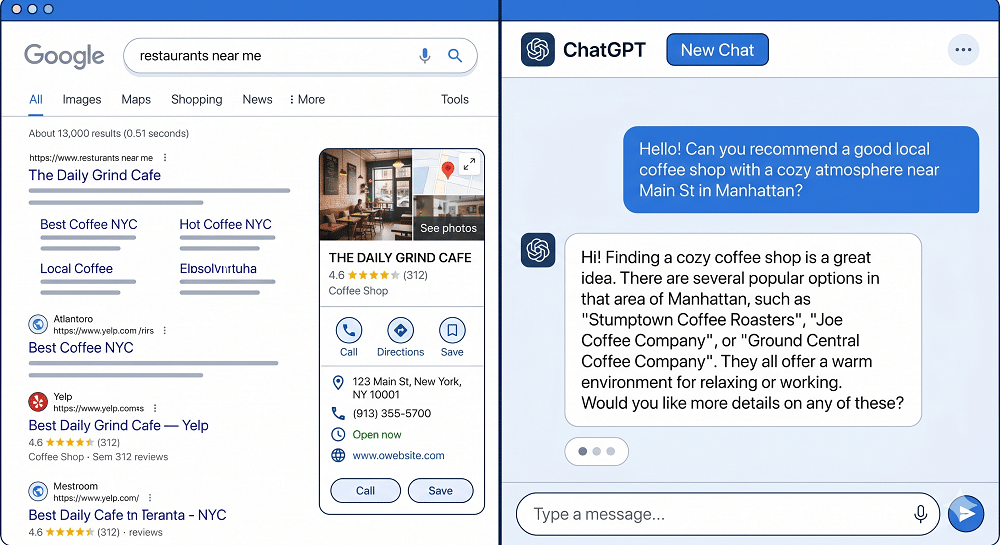
Your business isn’t appearing in ChatGPT because AI models rely on structured, high-trust, and widely cited data rather than traditional keyword stuffing. To fix the issue, you must optimize for “Generative Engine Optimization” (GEO) by building a consistent digital footprint across directories, using Schema markup, and creating FAQ-driven content.
You’ve put real work into your website. You rank on Google. Your SEO is solid. But when someone opens ChatGPT and asks about services in your industry, your business doesn’t come up. Not even once. That’s not a fluke. It’s a structural problem, and it has a name: a Generative Engine Optimization (GEO) gap.
At Texas Web Design, our team brings over 50 years of combined digital marketing experience, and GEO is quickly becoming one of the most important conversations we’re having with San Antonio businesses. AI referral traffic grew 527% year over year, comparing January through May 2025 to the same period in 2024, and ChatGPT alone now handles nearly one in ten of the search-related activities that Google processes daily.
If your business isn’t optimized for AI visibility, you’re missing a fast-growing channel that your competitors are already moving into. Get a free digital marketing consultation with our team today, and let’s find out where you stand.
Why Your Business Isn’t Showing Up in ChatGPT the Way It Shows Up on Google
ChatGPT and Google use completely different systems to surface information. Google ranks pages on your site. ChatGPT cites sources it trusts based on external signals, content structure, and entity consistency across the web. Understanding that difference is the first step toward closing the gap.
Google Ranks Pages. ChatGPT Cites Sources It Trusts.
Google evaluates your website directly, including its speed, its backlinks, and its keyword usage, and ranks it on a results page. ChatGPT doesn’t build a list of links. It generates a response and pulls from sources it has been trained on or can retrieve, favoring content it can verify through multiple independent signals. If your business only exists on your own website with minimal external presence, ChatGPT has little corroboration to work with and will default to competitors who do.
AI Models Look for Entity Clarity
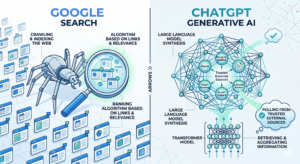 When AI engines try to surface a business, they’re looking for consistency. Is the business name the same across your website, your Google Business Profile, directories, and third-party mentions? Does the content consistently describe what you do, who you serve, and where you operate? Brands that send mixed or vague signals get skipped. Brands with clear, consistent entity information get cited.
Content Structure Matters More Than It Did Before
A webpage that reads well for a human visitor may not be easily extractable by an AI engine. AI tools are specifically looking for direct answers to questions, structured information, and content that clearly defines terms and topics. Academic research presented at ACM KDD 2024 found that adding citations to content improved AI visibility by 115% for lower-ranked content and that adding statistics improved AI citation rates by 41%.
The Most Common Reasons San Antonio Businesses Are Invisible in ChatGPT
Most businesses missing from AI search results share the same three problems: thin content, no external presence, and inconsistent business data. Here is what each one looks like in practice.
Thin or Unstructured Website Content
A website with short page descriptions, minimal blog content, and no clear answers to the questions your customers are actually asking gives AI engines very little to work with. AI tools prioritize content that directly and completely answers a specific question. If your service pages are mostly visual with minimal text, or if your blog hasn’t been updated in years, your content isn’t structured in a way that AI can extract and cite.
No External Mentions or Third-Party Presence
Your own website telling the world you’re a great business is the digital equivalent of writing your own reference letter. AI engines want external validation, including mentions in industry publications, local directories, review platforms, and news coverage. If your business doesn’t exist in credible third-party sources, AI tools can’t corroborate what your website claims and won’t cite you.
Missing or Inconsistent Business Data Across the Web
Name, address, phone number, and service descriptions need to match across every platform where your business appears. Inconsistency across directories, your Google Business Profile, Yelp, and industry listings create what AI researchers describe as diverging semantic vectors. Essentially, the AI can’t resolve your business as a single, trustworthy entity and passes you over for a brand it can verify cleanly.
How to Show Up in ChatGPT: A Practical GEO Strategy for San Antonio Businesses
To show up in ChatGPT, your business needs structured content that AI can extract, a consistent external presence that AI can verify, and clear entity signals across every platform where your business appears. GEO isn’t a replacement for search engine optimization services. It’s a layer on top of it. The foundations are the same: good content, technical health, and external authority. But the specific signals that AI engines weight are different.
Restructure Your Content Around Direct Answers
Every major page on your professional web design should open with a clear, direct answer to the question that page is meant to address. If you have a service page about web design in San Antonio, the first paragraph should directly state what you do, who you serve, and what outcome the customer can expect. FAQ sections, definition blocks, and clearly labeled how-to content all measurably improve AI extractability.
Build External Presence Consistently
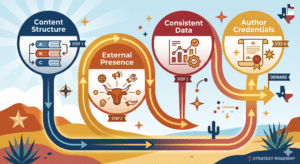 Start with the high-authority directories relevant to your industry and location, including Google Business Profile, Yelp, the Better Business Bureau, and industry-specific platforms. Then pursue editorial mentions: local news coverage, guest posts on relevant industry sites, and citations in roundup articles. Each consistent external mention strengthens the AI’s confidence that your business is who you say it is.
Publish Content That Answers Real Questions
The most reliably AI-visible content is content that answers questions your customers are actually asking. Blog posts structured around specific questions, written in clear language with concrete answers, are what AI engines are trained to extract and cite. Generic content about your industry doesn’t move the needle. Content that provides a specific, credible, well-structured answer to a specific question does.
Add Author Credentials and Verifiable Expertise
AI engines weigh E-E-A-T signals (Experience, Expertise, Authoritativeness, and Trustworthiness) heavily. Author bios that include credentials, years of experience, and verifiable expertise help AI tools treat your content as a trustworthy source rather than generic web copy.
What This Means for Your San Antonio Business
GEO is not a future concern. ChatGPT accounts for 87.4% of all AI referral traffic to websites as of Q1 2026, according to the Conductor GEO Benchmarks Report. Gartner has predicted that traditional search engine volume will fall 25% by 2026 as AI tools handle more queries directly. The businesses that are investing in AI visibility now are building an advantage that compounds. The more your brand gets cited, the more trustworthy AI engines consider it, and the more it gets cited again.
The good news is that GEO rewards the same fundamentals that good web development services and SEO have always required: clear content, honest expertise, and a consistent presence across the web. If those foundations are already in place, adding GEO optimization is a focused effort. If they’re not, GEO gives you one more compelling reason to build them now.
At Texas Web Design, our digital marketing services help San Antonio businesses build the content structure, external presence, and technical foundation that AI search engines reward. Whether you’re starting from scratch or already ranking well on Google but invisible in AI results, we can help you close the gap. Call us today at 210-985-8528 to schedule your free consultation.
Frequently Asked Questions
What is GEO and how is it different from SEO?
Generative Engine Optimization is the practice of optimizing your content and online presence so that AI-powered search tools like ChatGPT, Perplexity, and Google AI Overviews can understand, trust, and cite your business in their responses. Unlike traditional SEO, which focuses on ranking positions in a list of search results, GEO focuses on becoming the source that AI engines pull from when generating direct answers to user questions.
Why does my business show up on Google but not in ChatGPT?
Google and ChatGPT use fundamentally different signals to surface information. Google ranks your website based on technical performance, backlinks, and keyword relevance. ChatGPT looks for external corroboration, clear content structure, and a consistent entity presence across multiple independent sources. A business can rank well on Google while remaining largely invisible to AI engines if its content isn’t structured for AI extractability and its external presence is thin.
How long does it take to show up in ChatGPT after optimizing?
Most businesses begin seeing improvement within two to three months of sustained GEO effort across content, external citations, and review platforms. Businesses with no external presence at all may see early signals within a few weeks of earning new mentions in credible sources. The timeline varies based on your starting point and how competitive your industry is in AI search.
Does my website help me show up in ChatGPT?
Yes, but not in the same way it helps with Google. A well-structured website with clear, direct answers to customer questions, proper use of headings, FAQ sections, and credible author information all improve AI extractability. However, website content alone is not sufficient. AI engines also require external validation from third-party sources before they will consistently cite a business.
What kind of content helps you show up in ChatGPT?
Content that directly and completely answers a specific question performs best in AI search. This includes FAQ pages, how-to guides, definition-based content, and service pages that open with a clear statement of what the business does and who it serves. Content that includes statistics from credible sources, citations to external references, and named author credentials performs measurably better than generic informational copy.
Will GEO replace SEO?
GEO is not replacing SEO. It is an additional layer on top of it. The technical foundations that make a website rank well on Google, including fast load times, clean code, strong content, and authoritative backlinks, are also beneficial for AI visibility. GEO adds specific practices around content structure, entity consistency, and external presence that traditional SEO doesn’t fully address. Businesses need both.
How do I check if my business is showing up in ChatGPT?
Open ChatGPT and ask the questions your customers are most likely to ask when looking for a business like yours. Include your city and service type. If your business name doesn’t appear in the responses, you have a GEO gap. Run the same queries in Perplexity and Google AI Overviews. Checking across multiple AI platforms gives you a clearer picture of where your visibility stands and where the largest gaps are.
Can Texas Web Design help my business get found in ChatGPT and AI search?
Yes. Texas Web Design helps San Antonio businesses build the content structure, external presence, and technical foundation that AI search engines use to evaluate and cite brands. Our team works across SEO, content strategy, and web design to improve AI visibility alongside traditional search performance. Contact us at 210-985-8528 or visit our website to schedule a free consultation.
