
San Antonio businesses are switching to AI-optimized SEO to improve local search visibility, enhance user intent targeting, and compete in AI-driven search results like Google AI Overviews. By leveraging AI, local companies can create more relevant, conversational content and adapt instantly to changing search algorithms, resulting in higher qualified leads and a competitive edge in a fast-evolving digital landscape.
The first page of Google is no longer the only battleground for online visibility. When a potential customer asks ChatGPT, Gemini, or Perplexity for the best roofer in San Antonio, the AI answers conversationally without ever linking to a ranking page. When they search Google, an AI Overview often summarizes the answer before the traditional blue links appear. San Antonio business owners are noticing, and the smarter ones are adapting their SEO strategy.
At Texas Web Design, our team brings years of digital marketing experience to San Antonio businesses navigating this shift. We have watched search change from Yellow Pages to Google rankings to AI-generated answers, and the strategies that worked in each era do not work in the next without adjustment.
Schedule a free consultation today by calling us at 210-985-8528 and discuss how AI-optimized SEO applies to your business.
What AI-Optimized SEO Actually Means
AI-optimized SEO combines traditional search engine optimization with two newer disciplines: Answer Engine Optimization (AEO) and Generative Engine Optimization (GEO). AEO focuses on being cited inside AI-powered answer features like Google AI Overviews and Perplexity. GEO focuses on being referenced by large language models like ChatGPT, Claude, and Gemini inside their generated responses.
The Shift from Traditional SEO to AEO
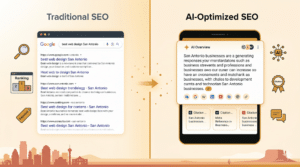
Traditional SEO optimizes for organic rankings on Google’s search results page. AEO optimizes for inclusion inside the AI-generated summary that now sits above those results, often producing a zero-click search. The difference matters because Google AI Overviews already appear in a significant share of searches. Sites cited in an AI Overview see roughly a 35% click-through rate boost, while sites in positions 1 through 3 without citation lose about 34% of their previous clicks.
How AI Search Engines Select and Cite Content
 AI search engines use retrieval-augmented generation (RAG) to pull from indexed pages, evaluate them for clarity and authority, and synthesize the best answer. Research analyzing 17 million AI citations found that AI-surfaced URLs are roughly 26% fresher than traditional search results. Structured content, direct answers, and authoritative sources are disproportionately favored by the citation algorithms.
Google AI Overviews, ChatGPT, and Perplexity Want Different Things
Each platform has its own citation preferences. ChatGPT cites Wikipedia disproportionately often at about 48% of its references. Google AI Overviews pull from Reddit at roughly 21% of citations. Perplexity leans heavily on YouTube for visual and how-to queries. Optimizing only for one platform misses the others.
Why the Shift Matters for San Antonio Businesses
The business impact of AI search is no longer theoretical. EMARKETER forecasts that roughly 31% of US consumers will use generative AI search in 2026, and Gartner projects traditional search volume will drop by 25% as AI chatbots and virtual agents absorb more queries.
Fewer Clicks, More Zero-Click Searches
Approximately 60% of searches now end without a single click to any website because users get their answers directly from AI summaries and SERP features. For a San Antonio business that relies on organic traffic, this trend means ranking in Google alone no longer guarantees visits. Appearing inside the AI-generated answer becomes the visibility surface that drives brand awareness and consideration.
Local Search Is Changing Too
When someone asks an AI assistant for a plumber, dentist, or contractor in San Antonio, the AI builds its answer from Google Business Profile listings, review sites, authoritative local content, and schema-marked web pages. A business with an optimized Google Business Profile, consistent NAP data, and AEO-friendly content is far more likely to be named in the response than one with none of those signals.
First-Mover Advantage in San Antonio
Most San Antonio businesses have not updated their SEO approach for the AI era. That creates a window. Brands that invest in AEO and GEO now establish themselves as the cited source for their industry before competitors catch on. Partnering with a San Antonio search engine optimization team accelerates the shift, and by the time late adopters begin optimizing in 2027 or 2028, the established AI citations will favor the brands that acted first.
Core AI-Optimized SEO Strategies That Actually Work
Switching to AI-optimized SEO is not about abandoning traditional SEO. It is about layering new tactics on top of a strong SEO foundation so that your content ranks well in Google and gets cited by AI platforms.
Structured Data and Schema Markup
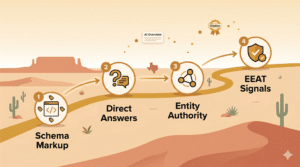 Schema markup, typically implemented in JSON-LD format using the Schema.org vocabulary, gives search engines and AI models a standardized way to understand your content. FAQ schema, HowTo schema, LocalBusiness schema, and Article schema all send explicit signals that help AI engines parse and cite your pages correctly. Clean schema implementation is often built into professional web design services, since pages with proper markup consistently outperform unmarked pages in AI citations.
Question-Based Content and Direct Answers
AI engines extract direct answers to specific questions, much like the featured snippets era but with higher stakes. Content organized around the exact questions a prospect would ask, with each answer front-loaded in 50 to 100 words, is three times more likely to be cited than long-form content without clear answer blocks. FAQ sections, H2 and H3 headings phrased as questions, and tight summary paragraphs at the top of sections all help.
Entity-Based Content and Topical Authority
AI models work with entities: people, places, concepts, and the relationships between them mapped in systems like the Google Knowledge Graph. Content that mentions authoritative entities, related concepts, and industry-standard terminology signals topical authority. For a San Antonio business, this means explicitly linking your content to recognized local entities, industry credentials, and measurable outcomes rather than vague claims.
EEAT Signals and Source Credibility
Google’s Quality Rater Guidelines formalized Experience, Expertise, Authoritativeness, and Trustworthiness (EEAT), and AI engines use similar signals to decide which pages to cite. Bylined content from named experts, verifiable credentials, original data, and citation of authoritative third-party sources all strengthen these signals. EEAT is no longer optional; it is the credibility layer that determines AI citation eligibility.
What San Antonio Businesses Should Do Next
AI-optimized SEO is not a replacement for traditional SEO but an expansion of it. Your content still needs to rank, and your website still needs to load fast and convert. What changes is the structure of how your content is written and marked up so that AI engines can find, understand, and cite it.
If you want an experienced team to audit your current content, schema implementation, and AI visibility, Texas Web Design helps San Antonio businesses modernize their SEO for the AI era. Whether you need a refreshed strategy or a paired digital advertising campaign while AEO takes hold, our team can walk you through exactly what to prioritize.
Contact us today to schedule your free consultation.
Frequently Asked Questions
What is AI-optimized SEO?
AI-optimized SEO is the practice of structuring content with schema markup, direct answers, and entity signals so it performs well in both traditional search results and AI-powered answer engines like Google AI Overviews, ChatGPT, Perplexity, and Bing Copilot. It combines classic SEO tactics with Answer Engine Optimization (AEO) and Generative Engine Optimization (GEO).
How is AEO different from traditional SEO?
Traditional SEO optimizes for page rankings on search results. AEO optimizes for inclusion inside the AI-generated answer summary that often appears above the rankings. AEO emphasizes direct answers, schema markup, topical authority, and EEAT signals, which AI engines use to select citations.
Why are San Antonio businesses switching to AI-optimized SEO?
San Antonio businesses are switching because Google AI Overviews now appear in a large share of searches, ChatGPT processes 2.5 billion daily prompts, and roughly 60% of searches end without a click. Businesses that are not cited by AI engines lose visibility even when they rank well in traditional results.
Does AI-optimized SEO replace regular SEO?
No. AI-optimized SEO builds on top of traditional SEO rather than replacing it. Google still handles 90% of search market share, and ranking remains important. AEO and GEO add a new layer of visibility inside AI-generated answers that traditional SEO alone does not capture.
How long does AI-optimized SEO take to show results?
Most businesses see early AI citation activity within weeks to a few months, depending on the strength of their existing content and domain authority. Sites with strong SEO foundations see faster results because AI engines often pull from top-ranking traditional search content.
What types of content work best for AI citations?
Research reports, data-driven articles, comprehensive FAQs, how-to guides, and structured comparisons perform best. AI engines favor fresh content with clear answers, authoritative sources, and schema markup that makes the content machine-readable.
Is AI-optimized SEO relevant for small local businesses?
Yes. Local businesses benefit significantly because AI assistants are increasingly used for local queries like finding a plumber, dentist, or contractor. An optimized Google Business Profile combined with AEO-friendly website content dramatically increases the likelihood that an AI engine names your business in its local recommendations.
How do I measure success with AI-optimized SEO?
Track AI citation frequency, brand mentions in AI-generated content, referral traffic from AI platforms in Google Analytics, and conversion rates from AI-referred visitors. These metrics complement traditional SEO KPIs like organic rankings, impressions, and click-through rate rather than replacing them.
