
A near me search is a local search where Google uses the searcher’s location to rank nearby businesses. Google estimates that location from the device, saved home or work addresses, past activity, or the IP address, even when “near me” is never typed. In San Antonio, results shift from one neighborhood to the next, and a complete profile, recent reviews, and clear local pages decide who gets picked.
Near Me Searches
Near Me Searches: How San Antonio Customers Find Local Businesses
Get In Touch
Last Updated: November 5, 2026
Table of Contents
- What Is a Near Me Search and How Does It Work in San Antonio?
- How Does Google Know Where a San Antonio Searcher Is?
- What Does Current Research Say About How Local Customers Choose a Business?
- How Can a San Antonio Business Show Up in Near Me Searches?
- What Near Me Search Data Means for Your San Antonio Business
When someone in San Antonio types “plumber near me” into a phone, Google has to work out where that person is. Only then does it decide which local businesses to show.
At Texas Web Design, we handle local SEO for San Antonio businesses, and near me searches sit at the center of that work. This guide explains how those searches work and what current research says about the people making them.
Each section leans on a named source, from Google’s help pages to BrightLocal’s 2026 consumer research. Use the findings to check how your business appears to nearby customers.
What Is a Near Me Search and How Does It Work in San Antonio?
A near me search is any search where the person wants a nearby result, even without the words near me. Google treats a search for coffee shops as a local need. Your location “helps to show you nearby results, even if you didn’t include a location in your search,” its Search Help page says.
So a search for AC repair on a phone in Alamo Heights can behave like AC repair near me. Google fills in the place for the searcher, unless the search names one, like “coffee shops in Chelsea” in Google’s own example.
Google then ranks nearby businesses, and its Business Profile help page says local results are “mainly based on relevance, distance, and popularity” overall. Our guide to local SEO for San Antonio small businesses covers those factors.
How Does Google Know Where a San Antonio Searcher Is?
Google estimates where a searcher is from several sources used together, according to its Search Help page on location. The four main sources are the device itself, saved home and work addresses, earlier activity on Google, and the IP address of the connection.
Device Location on Phones and Computers
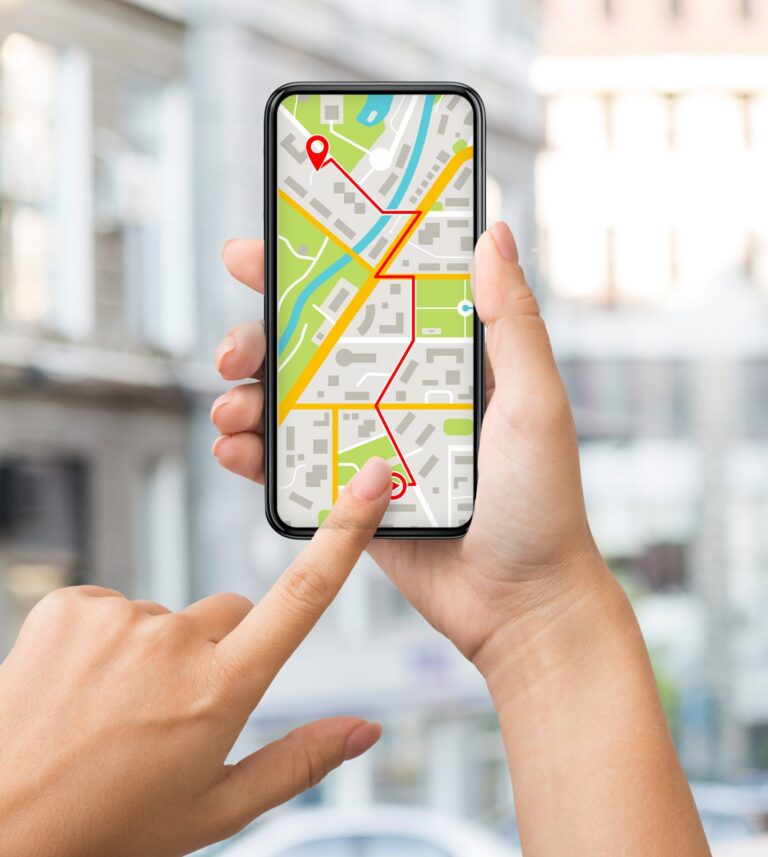
Phones matter most here. Pew Research Center’s 2026 survey found that 91% of U.S. adults own a smartphone. BrightLocal’s July 2026 report found that 73% of consumers started their latest local business search on mobile.
That makes the mobile view of your website the first impression for many local searchers. Our San Antonio web design work starts from that phone screen.
Saved Home and Work Addresses
Signed-in users can save a home and a work address in their Google Account. Google may use them “when it’s likely that you’re at one of these places,” its help page says.
Picture an office worker downtown who searches for a lunch spot at noon. Google may start from the saved work address, even with device location off.
The same person searching for a handyman on Saturday may be matched to home instead. One customer can sit in two parts of the city, depending on the hour.
Past Searches and Activity
Earlier searches can set the location for the next one. In Google’s example, a search for “coffee shops in Chelsea” followed by “nail salon” might show nail salons in Chelsea.
In San Antonio terms, someone who searches tacos in Southtown and then bakery may see Southtown bakeries first. The second search never named a place, but Google carried one over.
Google notes that turning off Search customization stops past searches from being used this way.
The IP Address and the General Area
Google can also use the IP address, which it says is “roughly based on geography” and points to a general area. Google always estimates at least that general area.
Google describes a general area as larger than 3 square kilometers with at least 1,000 users. So a desktop search without location on may be matched to a wide part of town.
The bottom of every results page shows how Google estimated your location. Our guide on how to check your ranking on Google shows how to see results from your customers’ side of town.
What Does Current Research Say About How Local Customers Choose a Business?
Local customers decide quickly and from a short list. BrightLocal’s June 2026 report, based on 1,227 U.S. consumers, found that 75% take less than 30 minutes to decide which business to use. In the same June 2026 report, 28% of people decided in under five minutes.
BrightLocal’s June 2026 research also found that 72% of consumers look at three or fewer businesses before deciding. In its July 2026 follow-up, proximity was the top research-stage factor, with 44% citing the address or how nearby a business is.
These figures cover U.S. consumers, with no San Antonio breakout. In a city this spread out, a business that misses the short list may never be compared at all.
Our guide on where to focus local SEO to attract nearby customers starts with visibility close to home.
How Can a San Antonio Business Show Up in Near Me Searches?
A San Antonio business shows up in near me searches with a profile Google can trust, recent reviews, and pages tied to real places. Each piece answers a step the research above describes, from the first search to the shortlist of three businesses.
A Business Profile That Matches the Search
Google says businesses with complete and accurate info “are more likely to show up in local search results,” and verification helps too. If yours is missing, see our checklist on why a San Antonio business isn’t showing up on Google Maps.
Keep “near me” out of your business name. Google’s guidelines say the name should match your real-world name, and extra words could lead to a suspension.
Your profile’s Performance report lists “the search terms people used to find your business,” updated monthly. Our Google Business Profile optimization service includes reading those insights.
Reviews That Survive a Three-Business Shortlist
When customers compare three or fewer options, reviews often settle the choice. BrightLocal’s Local Consumer Review Survey 2026 found that 68% of consumers will only use a business with four or more stars.
The same 2026 BrightLocal survey found that 74% look for reviews written in the last three months. BrightLocal notes older reviews may no longer be relevant after staff or service changes.
Ask customers for feedback right after a finished job, and reply to every review calmly and specifically.
Pages Written for Real Places
Repeating “near me” on a page adds little, since Google already supplies the location. Google’s spam policies list “blocks of text that list cities and regions” a page is trying to rank for as keyword stuffing.
Write service and area pages only for places you actually serve, with details specific to each one. Our San Antonio SEO services cover the on-page and content work behind this.
If you are unsure which areas deserve their own page, our contact form reaches our team.
Search Channels Beyond Google Search
Google still leads, but it is rarely the only stop. BrightLocal’s July 2026 report found that 52% of consumers started their latest local search on Google Search and 9% on Google Maps.
BrightLocal’s July 2026 report also found that 75% used more than one channel, and 23% used AI tools. BrightLocal’s 2026 review survey found Apple Maps use for reading reviews rose from 14% in 2025 to 27% in 2026.
Consistent details everywhere help each channel describe you the same way. Our comparison of ChatGPT vs Google for San Antonio customers looks at the AI side in more depth.
What Near Me Search Data Means for Your San Antonio Business
Near me searches reward the business Google can place, trust, and match to the job, and customers often choose within minutes. At Texas Web Design, we look at how San Antonio businesses appear from the neighborhoods their customers actually search in.
A complete profile and recent reviews are the first places to check, followed by your service and area pages. To see how your business shows up for nearby searches across San Antonio, speak with us at (210) 985-8528.
Frequently Asked Questions
How does a near me search work?
A near me search pairs what you searched for with Google’s estimate of where you are. That estimate can come from your phone’s location, a saved home or work address, earlier searches, or your IP address. Google then ranks nearby businesses on how well they match, how close they are, and how well known they are.
Do Google search results depend on location?
Yes, Google uses location to make results more helpful, and it always estimates at least the general area you search from. That is why two people in different parts of San Antonio can see different businesses for the same search. The bottom of each results page shows how your location was estimated.
How to rank for near me searches?
Start with a verified Google Business Profile that is complete, accurate, and set to the right category and service areas. Then build a steady flow of recent reviews and website pages that describe your services in the areas you serve. Google states there is no way to request or pay for a better local ranking.
How to use near me keywords?
Use near me keywords sparingly, because Google already adds the searcher’s location to the query. Write naturally about your services and the San Antonio areas you cover. Never add “near me” to your Business Profile name, and skip long lists of city names, which Google’s spam policies treat as keyword stuffing.
How do I find an SEO expert near me?
Search locally for SEO help, then compare SEO companies in San Antonio by reviews and past work. Ask how they would improve near me visibility and report progress monthly. Avoid guaranteed rankings, since Google says local ranking can’t be bought.