
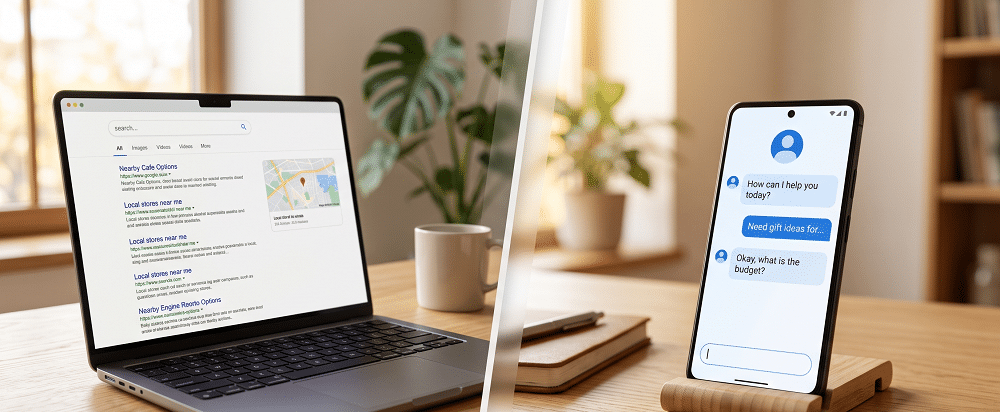
Most buying searches still run through Google, which holds about 85.51 percent of U.S. search share, while a fast-growing share of research now happens inside ChatGPT and other AI tools. The two channels serve different moments in the same buying decision. A San Antonio business that wants the call has to be visible in both, not just the one it already tracks.
For two decades the question was simple: where does my business rank on Google? That question still matters, but it no longer captures where every customer starts. A homeowner in Stone Oak might open ChatGPT to compare options, then jump to Google to confirm a name and grab a phone number.
This split changes how a local business gets found. The same person now moves between an AI assistant that explains and a search engine that verifies, often in the same hour. Watching only one of those paths means missing half of how the decision actually happens.
At Texas Web Design, we build and optimize websites across San Antonio and the Hill Country for both classic Google search and the newer AI engines, because our clients are losing leads they never see in any ranking report. If you are not sure where your customers are finding you, request a free search visibility check and we will map which channels send you traffic and which ones skip you.
Is Google Still Where Most San Antonio Customers Search?
Yes. Google still handles the overwhelming majority of searches, holding about 85.51 percent of U.S. search share as of May 2026 (Statcounter). For a local business, that means the bulk of “near me” and ready-to-buy searches continue to start on Google, where the Map Pack and local results sit.
 What has changed is what those Google results now look like. AI Overviews, the generated answer box at the top of many results, now trigger on roughly 25 percent of searches, up from about 13 percent in March 2025 (Conductor, based on a 21.9 million query analysis). So even a customer who searches Google may read a generated summary before they ever reach a list of links.
The takeaway for a San Antonio owner is that Google has not shrunk, but it has split. Ranking on the blue links is no longer the only way to win on the platform your customers still use most.
For a local service business, that split shows up in the searches that matter most. Someone looking for a contractor in Helotes or a studio in Alamo Heights still types the query into Google, but an AI Overview may answer part of their question before they scroll. Being the cited source inside that box now carries the kind of weight a top organic spot used to.
Who Is Actually Using ChatGPT, and for What?
ChatGPT has moved from novelty to habit faster than most owners realize. OpenAI reported that ChatGPT reached roughly 900 million weekly active users in early 2026, about double the figure a year earlier. The Pew Research Center found that 34 percent of U.S. adults have used ChatGPT, a share that rises to 58 percent among adults under 30.
That age skew matters for how you read your own market. Younger buyers, the same group buying first homes and booking first big-ticket services, are the most likely to open an AI assistant before they open a search engine.
People do not use ChatGPT the way they use Google, though. The questions tend to be broader and more exploratory, and the answers arrive as a short recommendation rather than a page of options. That difference shapes when, and how, your business needs to appear in the response.
- Comparing options: A user asks an assistant to explain the difference between two services or approaches before they have picked a direction.
- Shortlisting providers: Someone asks for the kind of company that handles a specific need in their area, looking for names rather than a list of links.
- Checking the basics: A buyer asks what a project usually involves or costs before deciding whether to call anyone at all.
- Drafting and planning: A user has the assistant help write the message they will eventually send to a provider.
Search vs Discovery: The Split-Path Model
The cleanest way to picture the two channels is by the job each one does. Google is mostly a search tool, where someone already knows what they want and is looking for the best match. ChatGPT is mostly a discovery tool, where someone is still forming the question and wants help thinking it through.
Most real buying journeys now cross both. A customer discovers and narrows inside an AI chat, then searches Google to verify a specific business, read reviews, and find the phone number. The table below lays out where each channel tends to lead in a typical local decision.
| Buying Stage | Channel They Reach For | What They Want |
|---|---|---|
| Exploring the problem | ChatGPT, Gemini, Perplexity | A plain explanation and a sense of their options |
| Shortlisting providers | AI assistant first, then Google | A few credible names worth checking |
| Verifying a business | Google Search and Maps | Reviews, location, hours, and a phone number |
| Ready to act | Google, direct visit, or a call | A fast, frictionless way to contact you |
Reading your visibility through this model changes the question. The point is not which platform wins overall, but whether your business shows up at each stage a San Antonio customer passes through.
Most owners only track the verify-and-act stages, because those are the searches that show up in their analytics. The discovery stage happens inside an AI chat where no ranking report can see it, which is exactly why a competitor can get named there without you ever knowing the conversation took place. Treating the journey as one connected path, rather than a single ranking, is what closes that gap.
What the Channel Mix Means for a San Antonio Business
For a local business, the practical lesson is that one strong Google ranking no longer covers the whole journey. A roofing company in Boerne can sit at the top of the Map Pack and still be absent from the AI answer a younger homeowner reads first. Each channel can quietly hand a lead to a competitor who happens to appear in the other.
The good news is that the work behind both channels overlaps more than it competes. The same clean structure, accurate business details, and direct answers that help Google’s AI Overviews also help ChatGPT and Perplexity understand and repeat your information.
Strengthen Your Foundation for Google
Google still rewards the basics done well: fast mobile pages, a complete and consistent Google Business Profile, and local content that names San Antonio and the neighborhoods you serve. These are the same fundamentals that have always driven local rankings, and they still decide who lands in the Map Pack when a nearby customer is ready to call. Our SEO services for San Antonio businesses focus on the signals that move local rankings and Map Pack placement.
Make Your Site Readable to AI Engines
AI tools cite sources they can parse and trust, which means schema markup, semantic headings, and quote-ready answers do the heavy lifting. A page that buries its answer in a long windup gives an engine nothing clean to lift, while a page that opens with a direct sentence becomes easy to quote. We cover the specific signals in our breakdown of what AI search engines look for in a website.
Keep Your Identity Consistent Everywhere
Both channels confirm who you are by checking whether your name, address, and phone match across your site, your profile, and the wider web. Mismatched details give Google a reason to rank you lower and give an AI engine a reason to leave you out entirely. A single old address in a directory listing or a phone number that differs from your footer is enough to introduce that doubt, so consistency is worth auditing before you chase anything fancier.
What Does It Cost to Track Only One Channel?

The cost is invisible, which is what makes it dangerous. When you watch only your Google ranking, the leads you lose inside an AI chat never appear in any report, so the channel can quietly bleed customers while your dashboard looks healthy. You cannot fix a gap you have no way to see.
Picture two similar contractors in New Braunfels. One has a clean, well-structured site with accurate schema and consistent details, so an AI assistant confidently names them when a homeowner asks for options. The other ranks fine on Google but is unreadable to the assistant, so they never enter the shortlist that homeowner builds before a single search happens.
By the time that homeowner reaches Google, they may already be searching the first contractor by name. The second business never lost a ranking and never saw the lead, because the decision narrowed somewhere their reports do not reach. Closing that blind spot starts with checking both channels on purpose, not assuming one stands in for the other.
How Do You Show Up in Both ChatGPT and Google?
You earn visibility in both by building one well-structured site that serves humans, search crawlers, and AI engines at the same time. The order of operations matters, because a clean foundation is what every channel reads from before anything else can help.
- Fix the structure. Use one H1, logical headings, and real lists and tables so any engine can map the page cleanly.
- Add structured data. LocalBusiness and Article schema turn your details into facts an engine can quote rather than guess at.
- Write answer-first content. Open each section with a plain sentence that answers the heading, which helps both featured snippets and AI summaries.
- Tighten local signals. Name San Antonio and your service areas in the body, not just the metadata, and keep your business profile complete.
A site built this way does not have to choose between Google and ChatGPT. It gives the platform your customers still use most and the tools they are adopting fastest the same clear answers to lift. The work compounds, too, because every fix that helps an engine read you also helps a human visitor understand you, which is the audience that actually signs the contract.
Cover Both Paths Before a Competitor Covers One for You
Your customers are no longer searching in one place, and the business that shows up across both the search and discovery paths is the one that gets the call. Tracking only your Google ranking leaves the AI side of the journey invisible, and that blind spot is exactly where leads quietly slip to a competitor who appears there instead.
At Texas Web Design, we build and optimize websites across San Antonio and Texas to be found by both traditional Google search and the AI engines your customers are adopting.
Call us today at 210-985-8528 for a free search visibility check, and we will show you exactly where you appear, where you do not, and which fixes close the gap fastest.
Frequently Asked Questions
Is ChatGPT replacing Google for search?
No, not for most buying searches. Google still holds about 85.51 percent of U.S. search share (Statcounter, May 2026), while ChatGPT is growing fast as a research and discovery tool that people often use before they search Google.
Where do most local customers actually start their search?
Most still start on Google, especially for “near me” and ready-to-buy searches that lead to a call or visit. A growing share of buyers, particularly younger ones, now begin by exploring options in an AI assistant first.
Why does my business appear on Google but not in ChatGPT?
Usually because your site lacks the structured data and clear, quote-ready answers that AI engines rely on, or your business details are inconsistent across the web. A Map Pack ranking does not guarantee an AI tool can confirm and cite you.
Do younger customers really use ChatGPT more?
Yes. The Pew Research Center found that 58 percent of U.S. adults under 30 have used ChatGPT, compared with 34 percent of adults overall, so age is a strong predictor of which channel a buyer reaches for first.
Should a San Antonio business invest in Google or AI search?
Both, because they cover different stages of the same decision. The foundation that helps one (clean structure, schema, accurate local details) is largely the same work that helps the other, so you rarely have to pick.
How do AI tools decide which businesses to mention?
They pull from sources they can read and trust, favoring sites with clear structure, schema markup, and consistent business information across the web. Strong reviews and an accurate profile make a business easier to confirm and recommend.
Does my website still matter if customers use ChatGPT?
Yes, more than ever. AI tools and Google both read your website to understand and verify your business, so a poorly structured site weakens you in every channel at once.
How can I tell where my customers are finding me?
Start by checking your analytics for referral sources, then search your own services in both Google and an AI assistant to see whether your business appears. A visibility check across both channels shows the gaps your reports alone will not.
