

When people begin planning a new web page, one of the first questions they ask is simple: How long should it be? Page length influences how readers process information, how search engines interpret value, and how well the page accomplishes its purpose.
A web page creates an experience shaped by structure, clarity, depth, and relevance. So, the right length is less about a fixed number and more about what visitors expect when they reach your site.
At Texas Web Design, we help clients work through these decisions every day. If you want insight tailored to your content goals, contact us to start your free consultation with our team today. We can help you build pages that support both visitors and search visibility.
Table of Contents
Key Takeaways
- The ideal length of a web page does not follow a fixed number. It depends on search intent, topic depth, and what visitors expect when they arrive.
- Search engines focus on clarity, relevance, and how well the content answers the query, not on word count.
- User experience factors such as layout, readability, and attention patterns influence how long a page should be.
- Different page types have different natural lengths. Service pages, educational articles, and product pages each require their own approach.
- Longer content works best for detailed topics, while shorter content fits simple questions or quick actions.
- A balanced page feels complete without unnecessary expansion, supported by helpful headings and an organized structure.
Why Page Length Matters

The best length supports understanding while matching the expectations behind the search. Your goal is to provide a complete, organized explanation of the topic without padding or unnecessary detail.
How Search Engines Interpret Page Length
Search engines do not rank pages by word count. They focus on how well the content answers the search query. Page length affects SEO only in how it supports clarity and usefulness.
Topic Coverage
A broad question requires more explanation. A narrow question does not. Search engines identify whether your page provides the level of detail users expect for the topic.
Related Concepts
Useful pages often touch on closely connected ideas. This helps search engines understand the context of your content without forcing readers through irrelevant sections.
User Behavior
Time spent reading, scroll activity, and return visits help show that a page is helpful. These signals come from clear, relevant content rather than long text blocks.
Search Intent
The match between what a person searches for and what your page delivers plays a major role in performance. Readers seeking a simple definition want brief content, while readers researching a subject expect more detail.
How User Experience Influences the Right Length
User experience helps determine how much information a page should contain.
Attention
Readers scan pages quickly. Well-organized sections help them stay focused, whether the page is long or short.
Visual Comfort
Short paragraphs and clear headings make content easier to absorb. This allows readers to move through longer pages without feeling overwhelmed.
Visitor Expectations
People arrive with assumptions about how much information they will need. A short answer feels right when the question is simple. A longer explanation feels right when the subject requires more depth.
How Different Page Types Influence Content Length
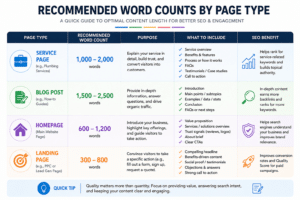 Different pages across a website serve different goals. Because of this, each page type has a natural length that supports its purpose and the expectations of its audience.
Service Pages
Readers want a clear explanation of what the service includes and why it helps. These pages usually fall in the middle range of length, with enough detail to inform without overwhelming.
Educational Articles
Guides and informational posts work well with more depth. Readers expect explanations, examples, and supporting details that help them understand the subject fully.
Product or Offering Pages
Simple products need brief descriptions. More complex offerings may require longer explanations, especially when features influence buying decisions.
Homepages
A homepage introduces the brand and directs the visitor to more specific pages. These sections remain shorter and rely on layout and structure to guide exploration.
Landing Pages
These pages are conversion-focused. Short content works when the offer is clear. Longer content works when visitors need more assurance before taking action.
Understanding these differences helps you shape page length based on purpose instead of following a single rule for the entire site.
When Longer Pages Make Sense
 Longer pages work well when readers expect detail, such as:
- Educational guides
- Service pages with multiple decision points
- Articles that answer several related questions
- Comparisons that help readers choose between options
These pages succeed when every section adds meaningful information.
When Shorter Pages Are More Effective
Shorter pages help readers who want quick information.
Common examples include:
- Simple service summaries
- Product listings
- Contact or location details
- Answers to narrow questions
Short content works best when the topic does not require deeper explanation.
Finding the Right Balance
A strong page feels complete without dragging on.
The following techniques help shape effective content:
- Use headings that guide readers through the topic
- Keep paragraphs focused
- Present ideas in a logical order
- Include examples only when they support understanding
This creates pages that feel natural to explore and easy to navigate.
How Professionals Help Determine Page Length
If you want confidence that your content meets both user and search expectations, a professional review can help. Texas Web Design studies search behavior, audience intent, and reading patterns to create pages that feel natural to explore.
With the right length and structure, your content becomes more useful to visitors and easier for search engines to interpret. If you want guidance on choosing the right length for your pages, call us today to start your free consultation.
Frequently Asked Questions
How long should a homepage be?
A homepage should be concise and focused on introducing the brand and guiding visitors to more specific pages. Homepages typically stay shorter than other page types, relying on layout, structure, and clear calls to action to direct exploration rather than lengthy content blocks.
Does page length affect SEO rankings?
Search engines do not rank pages by word count. They focus on how well the content answers the search query. Page length affects SEO only when it supports clarity and usefulness. A page that fully covers a topic with organized headings and relevant detail will outperform both thin content and unnecessarily padded content.
What is the ideal word count for a blog post in 2026?
There is no fixed ideal word count for blog posts in 2026. Educational guides and in-depth articles typically perform well at 1,200 to 2,500 words, while simple answer posts may only need 500 to 800 words. The right length depends on search intent, topic depth, and what competitors cover for the same keyword.
Should landing pages be long or short?
Landing pages should be short when the offer is simple and the visitor already understands the value. Longer landing pages work when visitors need more information, social proof, or reassurance before taking action. Test both lengths and measure conversion rates to determine what works for your specific audience.
How do you know if your web page is too long?
A web page is too long when it repeats points, includes filler content, or causes visitors to leave before reaching key information. Check your analytics for scroll depth and time on page. If most visitors only reach 30 to 40 percent of the page, the content may benefit from tightening or reorganization.
