

AI search engines (like ChatGPT, Perplexity, and Google’s AI mode) prioritize direct answers, structured formatting, and established trust. To win visibility, you must shift from “writing for keywords” to “writing for answers”. For a San Antonio business, this means optimizing for local context and machine readability.
If your website was built more than two or three years ago, you might already be losing visibility to a search world that did not exist when the site went live. AI Overviews now appear on a large and growing share of Google results pages, while ChatGPT, Perplexity, and Gemini answer questions directly. A San Antonio customer can research a service category, read an AI-generated summary, and make a decision before they ever click through to a website.
The shift is not slowing down. AI assistants pull the early-stage research that used to land on standard search engine results pages, and the sites they cite are not always the ones ranked first. AI engines decide whose content gets quoted based on a different set of signals than the ten blue links of a decade ago.
At Texas Web Design, we build and rebuild websites for businesses across San Antonio and the surrounding Texas region. Over the last two years, the same structural choices that always helped SEO now decide whether AI engines can read a site at all. What AI search engines look for in a website is a concrete, repeatable list of signals, and there is a real way to give it to them.
If your current website has never been reviewed for AI search readiness, request a free AI search readiness audit or call 210-985-8528, and our team will show you exactly which of these signals your site is sending and which are missing.
How AI Search Engines Decide What to Include in an Answer
Generative engines do not read a page the way a person reads it. They parse the underlying HTML, follow the heading hierarchy, pull text out of structured data, and look for short, quote-ready sentences they can repeat in a generated answer. When the page is built with clean, semantic markup, the engine can extract a clear claim and attribute it to your domain. When the page is a wall of styled <div> tags with no real structure, the engine usually skips it.
Schema markup adds another layer: structured data tells the engine what type of business runs the site, where it operates, what services it provides, and how to interpret the supporting content. Without schema, the engine has to guess. With it, the engine has facts.
The Core Signals AI Engines Reward
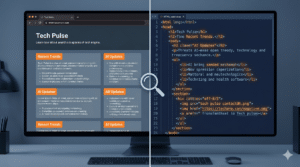 The core AI search ranking factors show up across every major generative engine’s behavior:
- Clean semantic HTML with a single H1 and a logical H2 and H3 hierarchy
- Schema markup that names the business, services, location, and key entities
- Direct, quote-ready answers in the first sentence of each section
- Fast mobile performance and stable visual layout
- Consistent business identity across the website and the wider web
- Author and organization detail that signals trust
Each step below addresses one of these signals. The order matters, because clean HTML has to come before schema, and schema has to come before quote-ready content can do its job.
Step 1: Build Clean Semantic HTML That AI Engines Can Parse
Semantic HTML is the part of the site nobody sees, and it is the part AI engines read first. Every heading, paragraph, list, and section needs the correct underlying tag, not just the right visual styling. A page that looks tidy in a browser can still be a structural mess underneath, and that underlying structure is what an AI engine actually parses.
We build and rebuild sites using inclusive web design built on clean semantic HTML, because the same patterns that help screen readers also help AI engines understand what a page is about.
A well-built page carries:
- Exactly one H1 per page that matches the page topic
- Logical H2 and H3 nesting with no skipped levels
- Real <ul> and <ol> lists for grouped items, not styled <div> blocks
- Real <table> elements for grid-shaped data with proper headers
- Descriptive alt text on every image that carries information
- Clear <section>, <article>, and <nav> regions so the engine can map the page
Step 2: Add Schema Markup So Engines Understand What Your Page Is About
Schema markup is structured data written in a format that AI engines and search engines both consume. It sits in the page source and translates content into facts the engine can rely on: business name, service area, services offered, hours, reviews, author, article topic. Google Search Central publishes the official guidance at developers.google.com/search/docs/appearance/structured-data/intro-structured-data, and the vocabulary itself (Schema.org) is supported by Google, Microsoft, Yahoo, and Yandex.
Every San Antonio business page should carry at least three schema types: LocalBusiness on the home page and key service pages, Article schema on every blog or info page, and Organization schema across the site. Service, Review, and FAQ schema strengthen the signal further.
The types that matter most:
- LocalBusiness: ties the page to a specific business, address, phone number, and service area
- Article: marks blog and info pages so AI engines can identify the topic, author, and publish date
- Organization: identifies your company as an entity with a name, logo, social profiles, and contact details
- Service: describes each service offered with its own page-level entity
- FAQPage: structures common questions and answers for AI Overview and rich result eligibility
- Review and AggregateRating: signals third-party validation when reviews are available
Our SEO services for San Antonio businesses include schema implementation, technical audits, and content structuring, because schema on its own without clean HTML or quote-ready content rarely earns citations.
Step 3: Write Quote-Ready Answers in the First Sentence of Every Section
A quote-ready answer is a single sentence that fully answers the question implied by the section heading, written in plain language a person can repeat out loud. AI engines look for these sentences specifically because they are the easiest blocks of text to lift into a generated answer.
The difference shows up most clearly side by side.
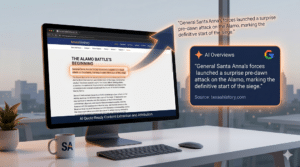 Section heading: How long does a website redesign take for a San Antonio business?
Setup-paragraph opener (low AI engine value):
- A website redesign is one of those projects where the timeline depends on many factors, and over the years we have learned that no two projects are exactly alike…
Quote-ready opener (high AI engine value):
- Most San Antonio business website redesigns take six to twelve weeks from kickoff to launch, depending on the number of pages, the depth of the content, and how quickly content is approved.
The second version answers the question in one sentence. An AI engine can quote it directly, attribute it to your domain, and use the supporting paragraphs for detail. Setup-style openers like the first version rarely make it into AI Overviews at all.
Step 4: Pass Core Web Vitals on Mobile, Not Just Desktop
Core Web Vitals are Google’s measurable standards for how fast and stable a page feels on a real device. They are one of the few performance signals AI engines can read directly, because the data lives in Chrome’s User Experience Report and is referenced by every major search platform. Failing Core Web Vitals on mobile usually keeps a site out of AI search results entirely.
Three numbers matter most:
- Largest Contentful Paint (LCP): how long the largest visible element takes to render. The target is under 2.5 seconds on mobile.
- Interaction to Next Paint (INP): how responsive the page feels when a user taps or clicks. The target is under 200 milliseconds.
- Cumulative Layout Shift (CLS): how much the page jumps around while loading. The target is under 0.1.
Mobile performance carries more weight than desktop because Google made mobile-first indexing the default for new sites in 2019 and completed the transition for all sites in 2024. We build using mobile-first development practices to keep these numbers in range, because mobile rebuilds after launch cost far more than building correctly the first time.
Step 5: Send Strong Local Signals So San Antonio Searches Surface Your Site
Local signals are the structured and unstructured details that tell AI engines where your business actually operates. A San Antonio site can fail AI search not because its content is weak, but because its location signals are inconsistent, hidden, or absent.
The basic local-signal checklist:
- A consistent NAP (Name, Address, Phone) across every page footer, contact page, and structured data block
- A LocalBusiness schema entry on the home page and key service pages, with the verified address and service area
- A Google Business Profile that matches the website’s NAP exactly
- Service-area pages or city-focused content that names the actual cities, regions, or counties served
- Internal links from supporting blog and info content back to local service pages
- City and region mentions inside body content, not buried in a footer or sidebar
For a San Antonio business, the site should signal San Antonio and Texas throughout the content, not just on a single “Areas We Serve” page. AI engines reward the consistency and tend to skip sites that only mention the city in metadata.
Step 6: Demonstrate E-E-A-T With Real Author, Business, and Citation Detail
E-E-A-T stands for Experience, Expertise, Authoritativeness, and Trustworthiness, and it is part of Google’s Search Quality Rater Guidelines. Generative engines borrow heavily from the same framework when they decide which sources to cite. A site that hides its author, leaves out business identity detail, or makes claims without any source rarely earns a spot in an AI-generated answer.
 Strong E-E-A-T signals come from a small set of consistent details:
- A real author byline on every blog and info page, with a short bio and a linked author profile
- Verifiable business information (license number, year founded, team page, real photos) across the site
- Citations to named sources whenever the content uses a statistic, regulation, or research finding
- Customer reviews displayed on the site with structured Review schema, not just star icons
- External authority links to government, academic, or industry sources when they support a claim
AI engines do not yet read every byline and every license number, but they do parse the structured data that points to them. Sites with this information laid out correctly show up most often as citations in AI Overviews and ChatGPT answers.
Work With a Web Design Team That Builds for AI Search
What AI search engines look for in a website is not optional anymore. Sites built before 2023 were designed for a search world that no longer exists, and the gap shows up first in lost visibility, then in lost leads. Businesses that adapt now spend less than those that wait, because every month of delay adds legacy code to untangle later.
Texas Web Design builds, rebuilds, and optimizes business websites across San Antonio and Texas for both traditional Google search and the new generative engines. If your site is missing structured data, slow on mobile, or written in a way AI engines cannot extract, talk with our team todayfor a free AI search readiness audit. Our team will identify what is blocking your visibility in AI Overviews, ChatGPT, and Perplexity, and prioritize the fixes that move fastest.
Whether your site needs a rebuild or a focused round of generative engine optimization, we will be honest about which path actually serves your business. AI search is moving fast, and the businesses building for it now are the ones still visible by next year.
Frequently Asked Questions About AI Search Optimization
Which AI search engines should a San Antonio business focus on first?
Google AI Overviews has the largest U.S. reach because Google still holds the dominant U.S. search share, but ChatGPT and Perplexity matter for any business whose customers research before they buy. We recommend optimizing once for the structural signals so the same fixes work across every major generative engine.
Do we need a completely new website for our business to appear in AI search results?
Not always. If the current site has clean code, valid HTML, reasonable mobile performance, and decent content depth, focused upgrades can be enough. Older template sites usually need structural fixes that are easier inside a rebuild.
How quickly can a San Antonio business start showing up in AI Overviews?
There is no fixed timeline. Well-structured local pages can begin appearing in AI summaries within weeks of indexing, while sites missing schema or basic semantic structure may never appear at all, no matter how long they wait.
Is schema markup really that important for AI search?
Yes. Schema turns content into structured facts that AI engines parse far more reliably than raw paragraphs, which is why LocalBusiness, Article, FAQ, and Review schema all matter for local visibility.
What is the difference between AI search optimization and traditional SEO?
Traditional SEO focuses on keyword presence, backlinks, and ranking position on a search engine results page. AI search optimization focuses on structural signals (schema, semantic HTML, quote-ready content) that decide whether AI engines can extract and cite the content at all.
Will AI engines pull from blog content or only from service pages?
Both. AI engines pull from any page on the site that answers a question well, which means blogs, info pages, FAQs, and service pages all matter. Topical depth across content types is what earns broader citation coverage over time.
Can a slow mobile site still appear in AI search answers?
Rarely. Mobile performance is a foundational signal that AI engines and Google’s mobile-first index both rely on, and slow sites usually drop out of consideration before content quality is even measured.
What is the biggest mistake San Antonio businesses make with AI search?
Treating AI search as a separate marketing tactic instead of a structural design issue. The fixes that help AI engines are mostly the same fixes that improve traditional SEO, mobile speed, and accessibility, which means a poorly built site has to be rebuilt before AI search optimization can do its job.
