

Future-proofing a San Antonio website for AI-powered search in 2026 requires shifting from traditional keyword-based SEO to Generative Engine Optimization (GEO). This strategy focuses on making content easily digestible, citable, and trustworthy for AI tools like Google Gemini, ChatGPT, and Perplexity. In 2026, AI search engines prioritize direct answers, structured data, and local authority over generic keyword stuffing.
Search has changed more in the past 18 months than in the previous decade. Industry tracking shows AI Overviews appeared on roughly 48% of tracked queries by February 2026, up from about 30% a year earlier, a 58% year-over-year jump. A #1 blue-link ranking no longer guarantees traffic for businesses from Stone Oak to Southtown.
At Texas Web Design, our team brings over 50 years of combined experience helping San Antonio businesses adapt to every shift in search, from Panda to mobile-first indexing. From our Alamo City home base, we’ve spent the last year auditing how AI Overviews, Google AI Mode, ChatGPT, and Perplexity choose citation sources, and we’ve rebuilt our San Antonio web design and SEO playbook around what works in 2026.
Contact us to schedule your free consultation today!
What is AI-powered search and why does it matter for San Antonio businesses?
AI-powered search is a generative discovery experience where large language models synthesize answers from indexed sources instead of returning ten blue links. The four primary surfaces are Google AI Overviews, Google AI Mode, ChatGPT search, and Perplexity. For San Antonio businesses, the stakes are concrete: organic CTR drops by 61% on AI Overview queries (from 1.76% to 0.61%), but cited pages earn 35% more organic clicks and 91% more paid clicks than pages that aren’t cited.
Visibility is binary. You either get cited or you get bypassed.
Three behaviors define how San Antonio searchers find local businesses today:
- They ask conversational questions like “best roofer near The Pearl” instead of 2-to-3-word keywords
- They trust the AI’s shortlist: in user behavior studies, 88% of AI Mode users took the AI’s shortlist without external check
- They expect local context: hours, ZIP codes like 78209 or 78258, and named service areas
How do AI search engines decide which websites to cite?
AI search engines select citations using three primary filters: semantic completeness, structured trust signals, and entity recognition. A 2025 industry analysis of 15,847 AI Overview results found that content scoring 8.5/10 or higher on semantic completeness is 4.2x more likely to be cited. Backlinks and domain authority still factor in, but no longer dominate.
Semantic completeness over keyword density
 Semantic completeness measures whether a page answers a question fully without forcing the reader to click elsewhere. LLMs read content as self-contained passages, not pages, and look for extractable answer blocks of 134 to 167 words.
Rewrite San Antonio service pages so each section opens with a definitive answer. A page about SEO services in San Antonio should open every H2 with a direct, lift-ready response.
Entity authority and branded mentions
AI engines verify your identity across the open web before citing you. A December 2025 study of 75,000 brands found that YouTube mentions and branded web mentions are the top two factors correlating with AI brand visibility. San Antonio businesses build entity authority through consistent NAP data on the San Antonio Chamber of Commerce, Express-News mentions, KSAT and News 4 coverage, and directories tied to 210 and 726 area codes.
Structured data as the AI translation layer
Schema markup is a machine-readable translation layer between your HTML and large language models. Pages with proper schema have a 2.5x higher chance of appearing in AI answers, and sites with complete Tier 1 schema see up to 40% more AI Overview appearances. JSON-LD is the format Google explicitly recommends.
What technical changes future-proof a website for AI-powered search?
Future-proofing for AI-powered search starts with the foundation Google has always rewarded: speed, mobile usability, structured data, and clean URLs. AI search raises the bar rather than rewriting it. Technical priorities for San Antonio businesses across Bexar County in 2026:
- Page speed under 2.5 seconds on mobile, since faster pages are more likely to be cited
- Mobile-first responsive design because Google indexes the mobile version first
- JSON-LD schema for Organization, LocalBusiness, FAQPage, and Article on every page
- Clean H1-to-H2-to-H3 hierarchy, never skipping levels
- HTTPS, canonical tags, and crawlable URLs for both Googlebot and AI crawlers like GPTBot
A modern, responsive web design is now table stakes. Without it, AI engines deprioritize your pages.
How should San Antonio businesses structure content for AI Overviews?
Structure content using four patterns AI engines reward: question-based H2s, direct 40-to-60-word answers, scannable lists, and FAQ sections that mirror Google’s “People Also Ask” queries. This format makes content extractable, the strongest predictor of citation.
Use question-based headings
Format H2s as questions a San Antonio customer would type or speak. Instead of “Our Services,” use “What HVAC services do you offer in Stone Oak?” or “How much does a kitchen remodel cost near Olmos Park?” These headings double as schema-friendly anchors and align with conversational AI Mode queries.
Write for extraction, not just reading
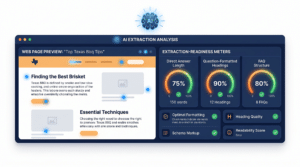 Open every section with a self-contained 40-to-60-word answer, then expand. This works because 44.2% of LLM citations come from the first 30% of a page (per a 1.2 million-response analysis). Intros and openers do the heaviest lifting.
Add real local context
San Antonio is a metro of distinct neighborhoods: Stone Oak, Alamo Heights, Helotes, Boerne, New Braunfels, Schertz, Olmos Park, plus inner-loop districts like Southtown, King William, and the Pearl. AI engines reward local relevance, and a landing page naming specific service areas, ZIP codes, and landmarks like the Riverwalk, La Cantera, or The Rim signals you’re a real local business.
Build topical depth, not isolated pages
Topical authority matters more than individual page rankings in AI search. A pillar page on “San Antonio web design” should connect to supporting articles on responsive design, WordPress e-commerce, and local SEO. Internal linking signals topical authority, and AI engines use it to choose which source to cite.
Where San Antonio Businesses Should Start
AI-powered search isn’t a future trend. It’s already shaping how customers find local businesses, with Google AI Mode reaching 75 million daily active users by late 2025, a 4x increase since its May 2025 launch. The San Antonio businesses that begin adopting AI search optimization now will own the answers AI engines surface for years.
The starting point is straightforward: combine technical SEO, structured content, schema markup, and entity-building into a single program rather than treating each as a separate project. Our team at Texas Web Design helps San Antonio businesses across every industry put that foundation in place, from medical practices in the South Texas Medical Center to restaurants on the Riverwalk to home services across Bexar County. Call us today!
Frequently Asked Questions
What is AI-powered search and how is it different from regular Google search?
AI-powered search is a generative discovery experience that synthesizes answers from multiple indexed sources instead of returning a list of links. Google AI Overviews, Google AI Mode, ChatGPT search, and Perplexity are the four primary surfaces. The difference: AI search summarizes and cites a small number of trusted sources, while traditional Google lets users pick from 10 blue links.
Will AI search hurt my San Antonio business's traffic?
It depends on whether your site gets cited. Sites that earn citations in AI Overviews see higher click-through rates and pre-qualified visitors. Sites that don’t earn citations see traffic drops of 20 to 40% on queries that trigger AI features. The risk is being bypassed entirely, which makes optimization more urgent, not less.
How do I get my website cited in Google AI Overviews?
Focus on semantic completeness, JSON-LD schema markup, question-based headings, and 40 to 60 word direct answer blocks at the top of every section. Build entity authority through consistent branded mentions across directories, social media, and trade publications. Local context (specific San Antonio neighborhoods and service areas) also helps.
Does schema markup actually matter for AI search in 2026?
Yes. Pages with proper schema markup have a 2.5 times higher chance of appearing in AI-generated answers, and sites with complete Tier 1 schema see up to 40% more AI Overview appearances. JSON-LD is the preferred format because AI engines parse it more easily than microdata or RDFa.
How long does it take to see results from AI search optimization?
Most San Antonio businesses see initial AI citation activity within 60 to 90 days of implementing technical and content changes, with stronger results at 6 to 9 months. AI engines need time to recrawl, evaluate entity signals, and build trust in your site as a verified source.
Do I still need traditional SEO if I'm optimizing for AI search?
Absolutely. AI search builds on traditional SEO foundations. Sites that already rank well for relevant queries are more likely to be cited by AI engines because Google’s AI systems use core ranking signals as inputs. Strong technical SEO, content quality, and backlinks remain the base layer.
What's the difference between AEO and GEO?
Answer Engine Optimization (AEO) formats content as the direct, extractable answer for voice search and AI assistants. Generative Engine Optimization (GEO) focuses on getting your brand cited and synthesized by generative AI engines like ChatGPT and Perplexity. Both work together, but they require slightly different content patterns.
How is local SEO changing for San Antonio businesses in the AI era?
Local SEO is more important, not less. AI engines weigh location signals heavily for queries with local intent, and they pull from Google Business Profile, Apple Business Connect, Yelp, the San Antonio Chamber of Commerce, Bexar County directories, and review sites. San Antonio businesses should keep NAP data consistent, publish neighborhood-specific content for areas like Alamo Heights, Stone Oak, and Boerne, and earn citations from local sources to strengthen entity recognition.
