
Core Web Vitals are three performance metrics Google uses to measure real-world user experience on your website: Largest Contentful Paint (LCP), Interaction to Next Paint (INP), and Cumulative Layout Shift (CLS). Google confirmed these metrics as official ranking factors as part of its Page Experience update. For San Antonio businesses competing in local search, failing Core Web Vitals thresholds can push your site below competitors whose content quality is otherwise equal. According to the 2025 Web Almanac, only 48% of mobile websites pass all three metrics, which means improving your scores is a direct competitive opportunity.
Core Web Vitals Explained
Core Web Vitals Guide for San Antonio Business Websites
Get In Touch

Most San Antonio business owners know their website needs to look good and rank in Google. Fewer know that Google also measures how their website feels to use, and that those measurements directly affect where it ranks. That is what Core Web Vitals are. They translate user experience into three specific, measurable numbers that Google evaluates for every page on your site.
At Texas Web Design, our team brings over 50 years of combined experience building websites that are fast, stable, and built to rank. If your site has never been tested against Core Web Vitals, schedule a free website performance audit or call 210-985-8528 to find out where it stands.
What Are Core Web Vitals and Why Do They Matter for San Antonio Businesses
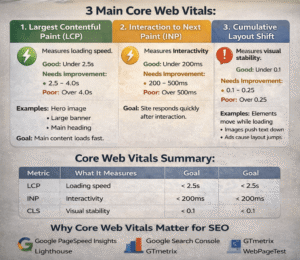 Core Web Vitals are three Google-defined metrics that measure loading speed, interactivity, and visual stability of a webpage using real user data. Google uses these scores as part of its Page Experience ranking signals, meaning they directly influence how your website performs in search results. For San Antonio businesses competing for local visibility, a site that fails these thresholds loses ranking ground to competitors whose pages meet them.
The three metrics are:
- Largest Contentful Paint (LCP) measures how quickly the main content of a page loads and becomes visible to the visitor.
- Interaction to Next Paint (INP) measures how fast the page responds when a visitor clicks, taps, or types.
- Cumulative Layout Shift (CLS) measures how visually stable the page is as it loads.
Google evaluates these scores using real visitor data collected through the Chrome User Experience Report (CrUX). A page must meet the thresholds for at least 75% of real-world visits to be rated as passing.
Breaking Down Each Core Web Vital
Each of the three metrics targets a different part of the user experience. A San Antonio business website can fail one, two, or all three, and each failure has a different root cause and fix.
Largest Contentful Paint (LCP): Loading Speed
LCP measures how long it takes for the largest visible element on a page to fully load. That element is typically a hero image, a heading, or a large block of text. Google defines a good LCP score as 2.5 seconds or under. Scores between 2.5 and 4 seconds need improvement. Anything above 4 seconds is considered poor.
For most San Antonio business websites, slow LCP comes from unoptimized images, slow server response times, or render-blocking code that delays the browser from displaying content. A well-built San Antonio web design addresses these from the ground up, using compressed image formats, fast hosting, and clean code that does not make visitors wait.
Interaction to Next Paint (INP): Responsiveness
INP measures how quickly your page responds to user interactions throughout the entire visit. This includes every click, tap, and keystroke, not just the first one. Google replaced the previous metric, First Input Delay (FID), with INP in March 2024 because FID only measured the first interaction. INP is a more complete picture of how the page behaves in use.
A good INP score is under 200 milliseconds. Scores between 200 and 500 milliseconds need improvement. Anything above 500 milliseconds is poor. Poor INP is almost always caused by heavy JavaScript that blocks the browser from processing user actions quickly. Professional web development that minimizes JavaScript load, defers secondary scripts, and avoids long-running tasks is the primary path to a good INP score.
Cumulative Layout Shift (CLS): Visual Stability
CLS measures how much the visible content on a page moves around unexpectedly while it loads. If a button shifts down just before a visitor taps it, or an image loads and pushes the text the visitor is reading, that registers as layout shift. Google defines a good CLS score as under 0.1. Scores between 0.1 and 0.25 need improvement. Anything above 0.25 is poor.
Common causes of high CLS include images that do not have defined dimensions, ads that load dynamically without reserved space, and web fonts that cause text to reflow once they load. A site built with responsive web design principles and proper dimension attributes for all media elements will naturally produce a stable, low-CLS experience.
How Core Web Vitals Affect Your San Antonio Search Rankings
Core Web Vitals are a confirmed Google ranking factor. They do not override content relevance, but when two pages are otherwise equal in quality and topical authority, the one with better Core Web Vitals scores will rank higher. For San Antonio businesses competing in local search, this is not a hypothetical scenario. It is the reality of how Google resolves competitive results.
Beyond rankings, Core Web Vitals directly affect how visitors behave on your site. A Deloitte study commissioned by Google found that a 0.1-second improvement in mobile site speed increased retail conversions by 8.4% and average order value by 9.2%. Poor LCP, INP, and CLS scores each erode that performance in measurable ways — slow loads increase abandonment, unresponsive interactions frustrate users, and unexpected layout shifts break trust mid-session. These are not abstract numbers for developers. They are measurable business outcomes.
For San Antonio businesses where most local search happens on mobile, the mobile Core Web Vitals scores matter most. Google uses mobile-first indexing, meaning your mobile performance is what determines your ranking, regardless of how your desktop site performs.
How to Check Your Core Web Vitals Scores
Google provides two primary tools for measuring Core Web Vitals, both free to use.
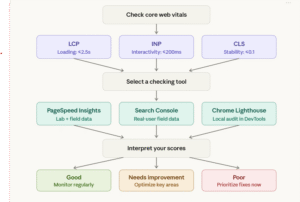 Google Search Console shows your site’s Core Web Vitals performance using real user data grouped by URL type. It flags which pages are in poor, needs improvement, or good status for both mobile and desktop. This is the most accurate representation of how Google sees your site’s performance because it is based on actual visitor behavior.
Google PageSpeed Insights runs a performance test on any individual URL and reports LCP, INP, and CLS scores alongside specific recommendations for improving each one. It combines lab testing with real-user data from CrUX when available.
If you have never run either of these tools on your San Antonio business website, that is a reasonable place to start. Both are free and take less than five minutes to run on any page.
What Failing Core Web Vitals Looks Like for a Local Business
According to the 2025 Web Almanac, only 48% of mobile websites pass all three Core Web Vitals metrics. For small and local businesses, the pass rate is even lower because most small business websites were built without performance optimization as a priority. Common symptoms include a site that loads slowly on mobile, pages that shift around while loading, or forms and buttons that feel unresponsive when tapped.
If your San Antonio website has any of these issues, the rankings and conversion impact is real and measurable. The good news is that Core Web Vitals failures are fixable. Image optimization, server upgrades, and code cleanup address the majority of LCP and CLS issues. JavaScript audits and script management address INP. Our SEO services San Antonio businesses rely on, include technical performance optimization as part of every campaign.
Core Web Vitals Are Part of a Larger Performance Strategy
Improving Core Web Vitals is not a one-time project. Google has stated it may update thresholds in the future as average web performance across the internet improves. Monitoring performance on a monthly basis through Google Search Console and testing new pages with PageSpeed Insights before launch is how high-performing San Antonio business websites stay ahead of the curve.
Core Web Vitals also do not exist in isolation. They sit alongside content quality, backlink authority, and local relevance as factors that determine where your site ranks. Addressing them as part of a broader digital marketing services strategy produces compounding results over time.
If you are ready to understand exactly where your San Antonio website stands on Core Web Vitals and what it would take to improve it, Texas Web Design is ready to walk you through it. Call 210-985-8528 to get a clear picture of what is holding your site back and what it would take to fix it.
Frequently Ask Questions
What are Core Web Vitals in simple terms?
Core Web Vitals are three scores Google uses to measure how a website feels to use in the real world. They measure how fast the main content loads (LCP), how quickly the page responds to clicks and taps (INP), and how stable the layout is while loading (CLS). Google uses these scores as part of its ranking system, meaning better scores contribute to higher positions in search results.
What are the passing thresholds for Core Web Vitals?
Google defines good scores as: LCP under 2.5 seconds, INP under 200 milliseconds, and CLS under 0.1. These thresholds must be met for at least 75% of real user visits to a page. Scores that fall between the good and poor thresholds are labeled “needs improvement.” Poor thresholds are: LCP above 4 seconds, INP above 500 milliseconds, and CLS above 0.25.
Do Core Web Vitals directly affect Google rankings?
Yes. Google confirmed Core Web Vitals as official ranking factors as part of its Page Experience update. They do not override content quality or relevance, but when two pages are otherwise equal in those areas, the page with better Core Web Vitals scores has a measurable ranking advantage. For competitive local search terms in San Antonio, that advantage is meaningful.
What replaced First Input Delay (FID) in Core Web Vitals?
Interaction to Next Paint (INP) replaced First Input Delay in March 2024. FID only measured the delay before the browser could respond to the very first user interaction on a page. INP measures responsiveness across every interaction a visitor makes during their entire session, making it a more complete measure of how the page performs in real use.
What causes poor Core Web Vitals scores?
Poor LCP is most commonly caused by large unoptimized images, slow server response times, and render-blocking JavaScript or CSS. Poor INP is usually caused by heavy JavaScript that occupies the browser’s main thread and delays responses to user actions. Poor CLS is typically caused by images without defined dimensions, dynamically loaded ads without reserved space, and web fonts that cause text to shift on load.
How do I check my website's Core Web Vitals?
Google Search Console provides Core Web Vitals data for your entire site based on real user visits, grouped by URL type and device. Google PageSpeed Insights tests individual pages and provides both lab scores and real-user data alongside specific improvement recommendations. Both tools are free and accessible to any website owner with a Google account.
How do Core Web Vitals affect mobile search performance?
Google uses mobile-first indexing, meaning it uses the mobile version of your website to determine rankings, regardless of how your desktop site performs. Mobile Core Web Vitals scores therefore carry the most weight in determining search position. San Antonio businesses where most local search traffic comes from mobile devices are most directly affected by mobile performance scores.
Can a San Antonio business improve its Core Web Vitals without rebuilding the site?
In many cases, yes. Common improvements include compressing and converting images to modern formats, adding dimension attributes to images and media, auditing and removing unnecessary JavaScript and third-party scripts, and improving server response times through better hosting or caching. How much improvement is possible without a rebuild depends on how the original site was built and how severe the existing performance issues are.