
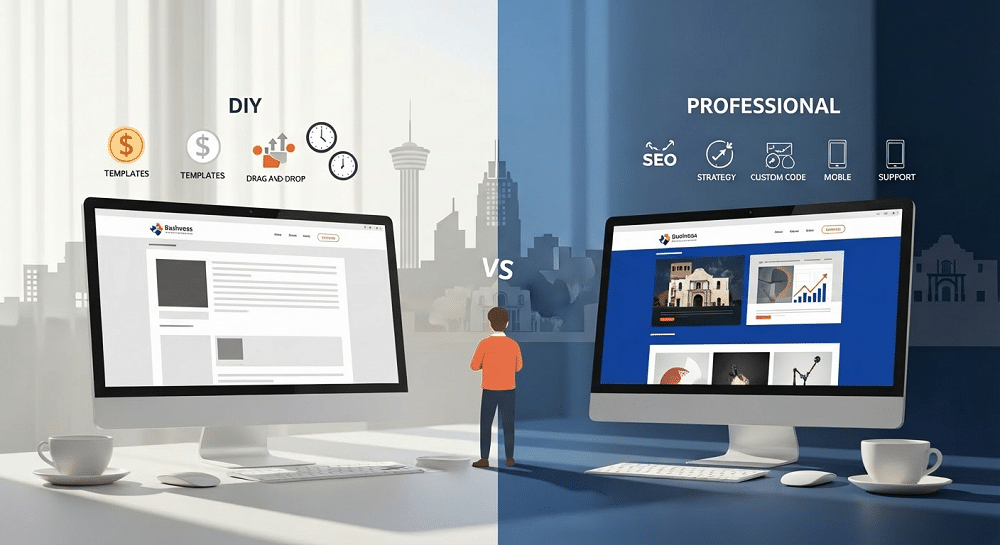
If you own a business in San Antonio, you have probably asked yourself this question: should I build my own website using a DIY platform, or should I hire a professional web design company? It is a fair question, and the answer is not the same for everyone.
At Texas Web Design, we have worked with hundreds of local businesses across San Antonio, from startups in Southtown to established companies in Stone Oak. We have seen what works, what does not, and what happens when business owners choose the wrong path for their situation. This article gives you an honest breakdown of both options so you can make the right call.
Have questions about your specific situation? Contact us today for a free consultation with our team.
Table of Contents
- Key Takeaways
- What Is the Difference Between DIY Website Builders and Professional Web Design?
- Why Does Website Choice Matter for San Antonio Businesses?
- When Should You Use a DIY Website Builder?
- What Are the Limitations of DIY Website Builders?
- What Does Professional Web Design Include?
- How Much Does a DIY Website Really Cost?
- How Do You Decide Between DIY and Professional Web Design?
- Ready to Discuss Your San Antonio Business Website?
- Frequently Asked Questions
Key Takeaways
- DIY website builders work best for testing business ideas, businesses that do not rely on online leads, or those with extremely limited budgets and available time to invest.
- Professional web design provides strategic planning, custom branding, technical optimization, local SEO expertise, and ongoing support that DIY platforms cannot match.
- Your website directly affects Google rankings through factors like page speed, mobile responsiveness, and user experience.
- The true cost of DIY includes 30 to 50 hours of your time, potential lost leads from poor search visibility, and the likelihood of paying for a rebuild later.
- San Antonio is a competitive market with over 1.5 million residents, making professional web design a competitive advantage for businesses that depend on online visibility.
- Ask yourself key questions before deciding: Does your business depend on online leads? Do you have the time? Are competitors using professional sites? What is your customer lifetime value?
What Is the Difference Between DIY Website Builders and Professional Web Design?

DIY website builders are platforms like Wix, Squarespace, and GoDaddy Website Builder that offer drag-and-drop interfaces for creating basic websites without coding knowledge. You select a template, add your content, and publish. Monthly subscription fees vary by platform and plan level.
Professional web design involves hiring a web design company to create a custom website for your business. This includes strategic planning, custom design, development, search engine optimization, and ongoing support. Investment levels vary based on project scope and complexity.
Both approaches produce a website. The difference lies in whether that website actively helps your San Antonio business attract customers and grow.
Why Does Website Choice Matter for San Antonio Businesses?
The majority of local searches now happen on mobile devices, with mobile accounting for roughly 60 to 70 percent of all Google searches. When someone in Alamo Heights searches for “best HVAC repair near me” or a family in Helotes looks up “pediatric dentist Stone Oak,” Google evaluates dozens of factors to decide which businesses appear first.
Your website plays a direct role in those rankings. Page speed, mobile responsiveness, structured data, and user experience all influence whether your business shows up when potential customers search. Clear menus are part of that, so see how to improve website navigation.
San Antonio is a competitive market. With over 1.5 million residents and thousands of local businesses, standing out online requires more than just having a website. It requires having a website that performs well in local search results.
When Should You Use a DIY Website Builder?
DIY website builders work best in specific situations:
- Testing a business idea: If you need a simple online presence to validate a concept, a DIY site can get you started quickly. Upgrade later once you know the business has legs.
- Businesses that do not depend on online leads: Some businesses operate through word-of-mouth referrals and need only a basic digital business card.
- You have 20 to 40 hours available: Building a decent DIY site requires this time investment. If you have the hours and enjoy the process, you can create something functional.
- Extremely limited startup budget: For businesses on tight margins during their first months, DIY can bridge the gap until revenue allows for professional investment.
What Are the Limitations of DIY Website Builders?
DIY platforms have limitations that become apparent when you need your website to drive real business results.
 Template restrictions reduce differentiation: When thousands of businesses use the same templates, your site looks like everyone else. Your San Antonio roofing company should not look like a yoga studio that happens to offer roofing services.
- SEO capabilities are limited: DIY platforms lack technical depth for competitive local search. Schema markup, advanced site architecture, and local business structured data are restricted or unavailable. When competing against professionally optimized San Antonio businesses, these limitations hurt your visibility in search results. This is the kind of technical work our San Antonio SEO services handle.
- Mobile experience often suffers: While DIY templates claim mobile responsiveness, elements frequently become clunky on phones. Given that most local searches happen on mobile, a subpar mobile experience costs you customers.
- You become responsible for all maintenance: Every update, fix, and security issue falls on you. Most business owners neglect their DIY site because they lack time to maintain it while running their actual business.
 Template restrictions reduce differentiation:
What Does Professional Web Design Include?
Professional web design delivers more than aesthetics. It builds a digital asset that supports your business goals.
- Strategic planning: Before design begins, a professional team learns about your business, customers, competitors, and goals. Your website is then designed specifically to convert visitors into customers.
- Custom design and branding: Your site reflects your unique brand and what differentiates your business in the San Antonio market. This is not a template with your logo swapped in. For features a template cannot handle, see when you need custom web development.
- Technical optimization: Professional sites feature clean code, fast load times, proper security, and search engine optimization built into the foundation.
- Local SEO expertise: A San Antonio web design company understands local search dynamics, optimizing for “near me” searches and Google Business Profile integration to help you rank in local results.
- Ongoing support and maintenance: When something needs updating, you have a team to handle it while you focus on running your business. Accessibility is one area worth reviewing, as covered in what to know about website ADA compliance.
How Much Does a DIY Website Really Cost?
The true cost of a DIY website extends beyond the monthly subscription fee. Time investment has real value. Building and maintaining a DIY site requires 30 to 50 hours. Consider what that time is worth to you and your business. Those hours spent on website building are hours not spent on revenue-generating activities.
Lost leads carry hidden costs. A website that ranks poorly in San Antonio search results or fails to convert visitors costs you business you never knew you lost.
Fixes and rebuilds add up. Many business owners start with DIY, hit limitations, pay for customization, hit more limits, then pay for a complete rebuild. The total often exceeds what professional web design would have cost from the start.
How Do You Decide Between DIY and Professional Web Design?
Ask yourself these questions to determine which option fits your San Antonio business:
 Does your business depend on attracting new customers through online search? If yes, professional web design offers a competitive advantage in the San Antonio market.
- Do you have 30 to 50 hours available to build and maintain a website while running your business? Be honest about your available time.
- Are your competitors using professionally designed websites? If so, a DIY site puts you at a disadvantage from day one in local search rankings.
- What is the lifetime value of a new customer? If one additional customer per month covers the cost of professional web design, the investment pays for itself. Before you sign with anyone, go through the website design questions to ask before hiring.
 Does your business depend on attracting new customers through online search?
Ready to Discuss Your San Antonio Business Website?
Whether you are starting fresh or reconsidering a DIY site that is not delivering results, the best next step is talking through your specific situation with a team that understands the San Antonio market.
At Texas Web Design, we offer free consultations where we assess your current online presence, discuss your business goals, and provide honest recommendations. No pressure, no obligation.
Call us at 210-985-8528 to schedule your free consultation today!
Frequently Asked Questions
How long does it take to build a professional website?
A professional small business website typically takes four to twelve weeks to complete. Simple sites with five to ten pages generally require four to six weeks, while more complex websites with custom features or e-commerce may take longer.
Can I switch from a DIY website builder to a professional website later?
Yes, but the transition requires rebuilding your site from scratch. DIY platforms like Wix and Squarespace use proprietary systems, meaning you cannot export your design or code to another platform. Your content and images can be migrated, but the site itself must be recreated.
Does website design actually affect my Google rankings?
Yes. Google evaluates user behavior signals like bounce rates and visit duration when ranking websites. Technical factors like page speed, mobile responsiveness, and site structure also directly influence how Google crawls and ranks your website.
What is the difference between web design and web development?
Web design focuses on visual appearance and user experience, including layout, colors, and how visitors interact with the site. Web development involves the technical coding that makes the website function. Professional web design companies typically handle both.
Do I need a new website if my current one is only a few years old?
Not necessarily. If your current website loads quickly, displays properly on mobile devices, and converts visitors into customers, it may only need updates. Most businesses benefit from evaluating their website every two to three years.
Why do some websites rank higher than others in local search results?
Local search rankings depend on Google Business Profile optimization, website relevance, proximity to the searcher, reviews, citation consistency, and website technical performance. Professional websites with proper local SEO implementation have a better chance of ranking well.
What should I look for when hiring a web design company?
Look for a relevant portfolio, client testimonials, clear communication, and transparency about timelines. Ask whether they provide ongoing support, how they handle SEO, and whether you will own your website files and domain.
How often should I update my business website?
Content updates should happen monthly or quarterly. Technical and security updates should occur as needed. A visual refresh every two to three years keeps your site looking current, with major redesigns typically needed every four to five years.
What makes a website mobile-friendly?
A mobile-friendly website automatically adjusts its layout to display properly on smartphones and tablets. This includes readable text without zooming, tap-friendly buttons, fast loading times, and no horizontal scrolling. Google primarily evaluates your mobile site for rankings.
Is it worth paying for professional web design as a small business?
For businesses that depend on attracting customers online, professional web design typically delivers positive return on investment through improved search visibility and higher conversion rates. If one or two additional customers per month would cover the cost, the investment often makes sense.
